Insights / Article
AI Customer Segmentation: Python & RFM Guide for Marketers
Learn how to combine RFM modeling and Python AI algorithms to segment customers, increase retention, and optimize lifetime value in marketing campaigns.
Back to insights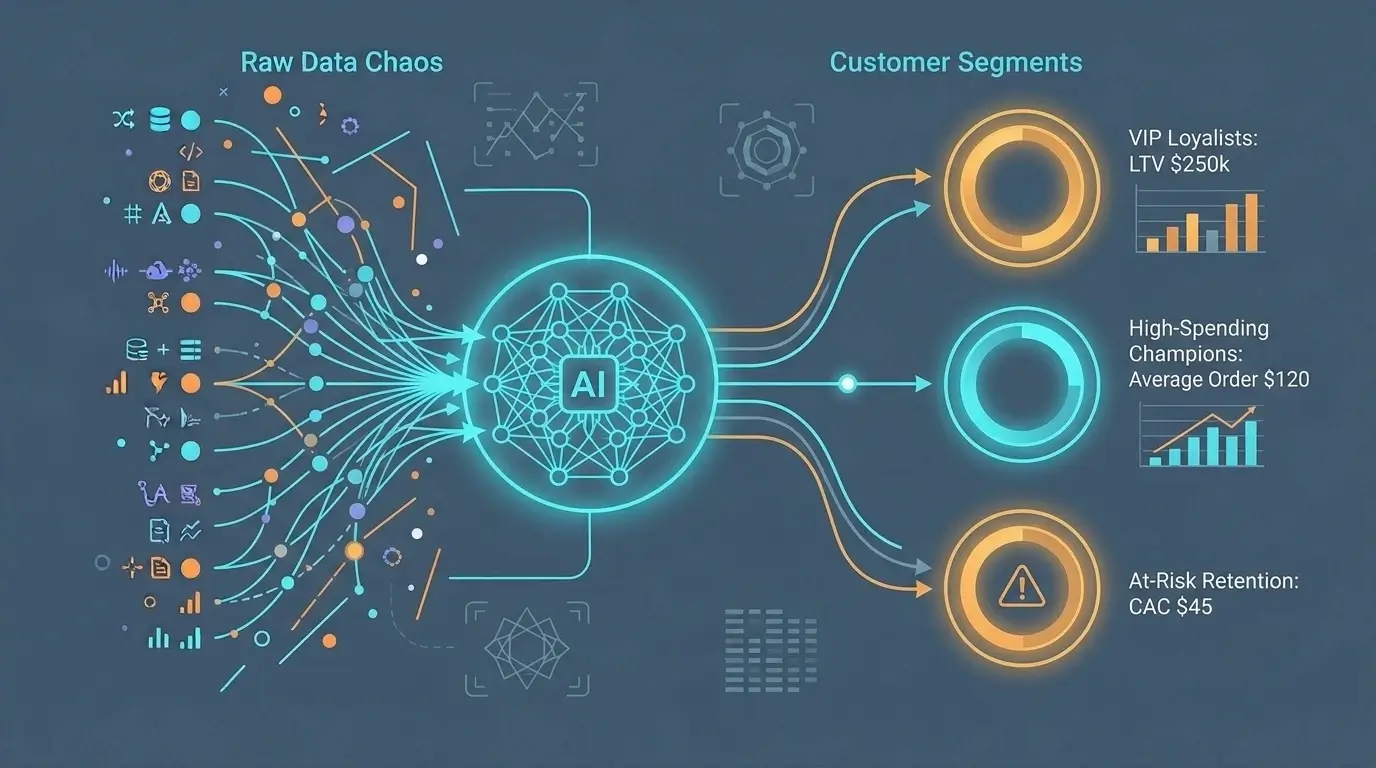
Predictive Customer Segmentation: How to Combine RFM Modeling with AI in Python
Broad, batch-and-blast marketing messages no longer deliver high conversion rates. Modern customers expect personalized experiences based on their specific behavior, purchase history, and engagement levels.
While basic demographic segmentation (age, location, gender) offers a starting point, it misses how customers actually interact with your business. Two users in the same city can have vastly different buying behaviors.
To build targeted marketing campaigns that increase retention and maximize Customer Lifetime Value (LTV), you need behavioral segmentation.
In this guide, we will explore how to combine a classic behavioral framework—RFM Analysis—with K-Means Clustering (Machine Learning in Python) to group your customers automatically and uncover actionable insights.
1. What is RFM Analysis?
RFM stands for Recency, Frequency, and Monetary Value. It is a proven database marketing model used to quantify customer behavior based on transaction history:
- Recency (R): How recently did the customer make a purchase? (Lower days = higher score)
- Frequency (F): How often do they purchase within a given timeframe? (Higher count = higher score)
- Monetary (M): How much total revenue have they generated for the business? (Higher spend = higher score)
Traditional Scoring vs. Machine Learning
Traditionally, analysts divide each metric into quartile ranks (1 to 4) manually in Excel. However, fixed manual rules miss subtle patterns. By applying AI clustering algorithms (like K-Means in Python), the data creates natural customer groupings dynamically based on mathematical proximity.
2. Preparing Customer Data in Python
To run an AI-driven RFM segmentation, transform raw transactional log tables into a clean per-customer summary table.
Python
3. Clustering Customers with K-Means AI
Machine learning algorithms require feature scaling because Monetary values (e.g., $2,000) operate on a completely different scale than Frequency values (e.g., 5 orders).
Python
4. Translating Machine Learning Clusters into Business Strategy
Once your Python model labels each customer, map those clusters directly to automated marketing campaigns:
Swipe sideways to see all columns. Keyboard: focus the table area and use the arrow keys.
| Cluster | Behavior Profile | Marketing Action Plan |
| Champions (High R, High F, High M) | Bought recently, buys often, spends the most. | VIP loyalty rewards, early product access, ambassador offers. |
| Loyal Customers (Med R, High F, Med M) | Buy regularly, responsive to promotions. | Cross-sell related products, offer subscription upgrades. |
| At-Risk (High R, High F, High M) | Spent heavily in the past, but haven't visited in months. | Personalized re-engagement campaigns, win-back discounts. |
| Lost / Dormant (High R, Low F, Low M) | Haven't purchased in a long time; low spend overall. | Low-cost automated email sequences; drop spend on ad retargeting. |
5. Connecting AI Segments to Action
Generating cluster labels in Python is only valuable if your marketing platforms can use them.
To turn this model into a production tool:
- Schedule Script Execution: Run the Python script weekly via cloud services (Google Cloud Functions or AWS Lambda).
- Sync Labels to CRM: Push the generated segment tags (
Champion,At-Risk, etc.) back into your CRM or email platform (HubSpot, Salesforce, ActiveCampaign) using API calls. - Track ROI in BI Tools: Monitor how campaigns targeted by behavioral clusters outperform broadcast campaigns in your Looker Studio or Power BI dashboards.
Key Takeaways
- Move Beyond Demographics: Behavioral metrics (RFM) predict future purchases far more accurately than age or location alone.
- Scale with Machine Learning: Use K-Means clustering in Python to automatically detect multi-dimensional customer patterns without manual rules.
- Actionable Targeting: Map every cluster directly to an automated marketing strategy to maximize retention and lower Customer Acquisition Cost (CAC).