Insights / Article
AI in Digital Marketing: 4 Ways to Automate Analytics
Learn how AI and automation transform digital marketing analytics—from predictive churn models to automated anomaly detection and campaign reporting.
Back to insights
The Future of Performance Measurement: How AI and Automation Are Transforming Digital Marketing
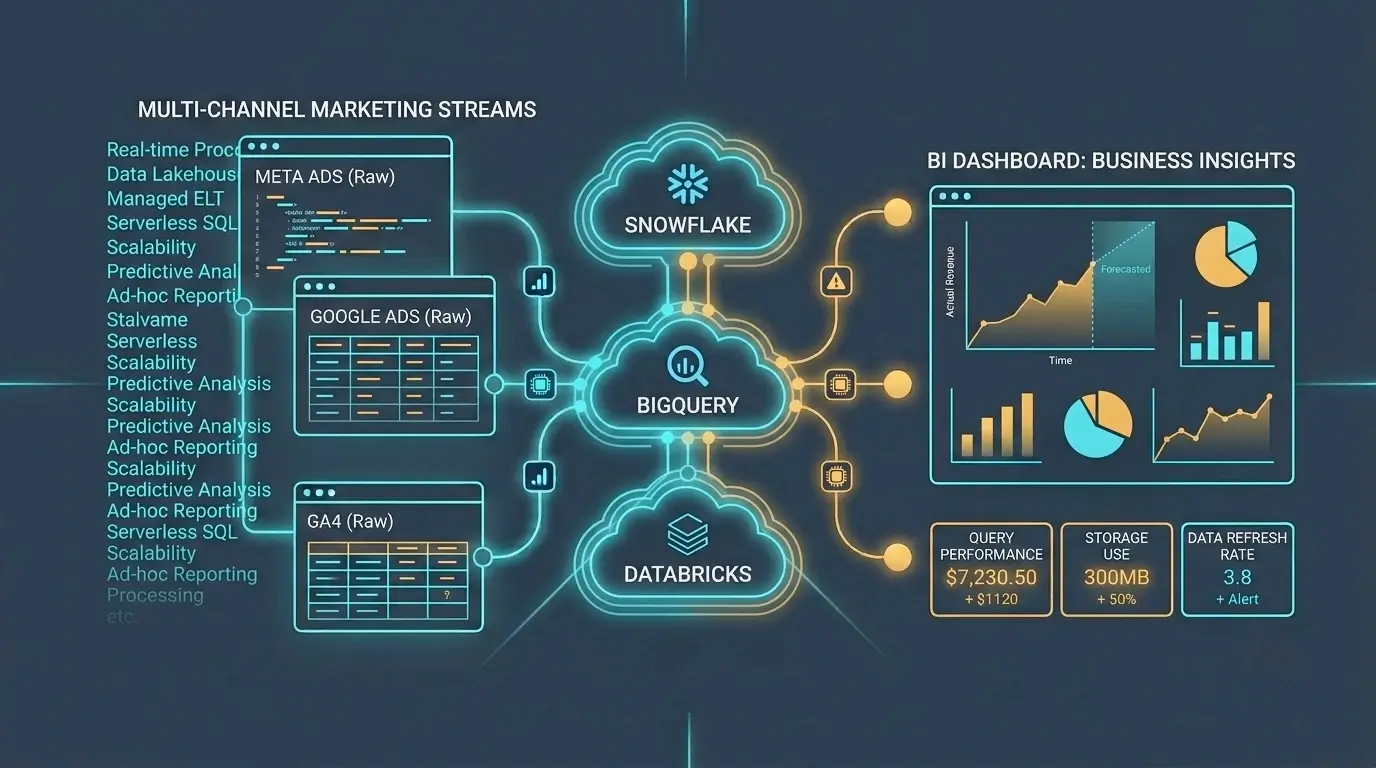
In digital marketing, speed to insight is everything. If it takes your team three days after the end of the week to manually gather ad performance data across Google Ads, Meta Ads, and GA4 into a spreadsheet, you are making optimization decisions using outdated information.
Traditional marketing analytics is inherently reactive—it tells you what already happened.
By integrating AI algorithms and automated data pipelines, marketing analytics shifts from reactive reporting to proactive prediction. Instead of spending hours aggregating CSV files, data analysts and marketers can focus on strategic decision-making and campaign optimization.
In this guide, we will explore four practical ways AI and automation are transforming digital marketing analytics and how you can apply them in your organization today.
1. Automated Data Extraction & Multi-Channel Attribution
The biggest operational bottleneck in marketing analytics is fragmented data. Campaign spend lives in ad platforms, web traffic lives in GA4, and conversion value lives in your CRM.
How Automation Solves It:
Instead of manual exports, Python scripts and ETL pipeline tools (like Fivetran or Airflow) pull data from native APIs automatically on a daily schedule.
- Standardized UTM Taxonomies: Automated scripts check incoming campaigns to ensure UTM parameters match your organizational naming conventions before processing.
- Unified Campaign Views: Automatically calculate true Customer Acquisition Cost (CAC) by joining ad spend directly with backend sales deals in SQL.
2. Automated Anomaly Detection for Ad Spend & Traffic
Nothing damages a marketing budget faster than a misconfigured campaign—such as accidentally setting a $500 daily budget to $5,000, or a tracking script breaking on a key checkout page.
Manually spotting these errors takes days. Automated anomaly detection flags them in minutes.
Practical Implementation:
By running basic statistical models (such as Z-score calculations or isolation forests in Python) on your daily metrics, you can trigger instant alerts via Slack or Email whenever traffic or conversion rates deviate significantly from historical baselines.
$$\text{Z-Score} = \frac{X - \mu}{\sigma}$$
(Where $X$ is today's metric, $\mu$ is the historical rolling average, and $\sigma$ is the standard deviation. A Z-score greater than $+3$ or less than $-3$ triggers an automated alert.)
3. Predictive Churn & Lifetime Value (LTV) Modeling
Traditional customer segmentation groups users based on past behavior. AI-driven predictive modeling forecasts future value.
Using machine learning algorithms (such as XGBoost or Logistic Regression) trained on historical purchase patterns, you can assign every customer two real-time probability scores:
- Churn Probability: The likelihood that a customer will stop buying within the next 90 days.
- Predicted 1-Year LTV: The expected net revenue the user will generate over the coming year.
Business Value: Instead of offering blanket discounts to all users, automatically trigger high-value win-back campaigns specifically for "High LTV, High Churn Risk" customers in your CRM.
4. AI-Powered Generative Performance Summaries
Executives rarely have time to read 10-page analytical PDFs. They want concise, actionable summaries of campaign results.
By connecting LLM APIs (like GPT-4o or Claude) to your clean, staging database tables, you can generate automated weekly executive summaries alongside your visual dashboards:
Python
Key Takeaways
- Move from Reactive to Proactive: Use automated pipelines to eliminate spreadsheet exports and deliver insights in real time.
- Protect Your Budgets: Implement automated statistical anomaly detection to catch tracking bugs and overspending early.
- Target by Future Value: Use predictive machine learning models to identify churn risks and focus retention budgets on high-LTV customers.